During your first few kayaking sessions you may notice that some people move along with apparently small, relaxed movements, while others send lots of water flying and tire quickly. That is not always a difference of physical strength. A paddle works better when used with appropriate posture, in coordination with body movement and at a pace that allows the action to be repeated without accumulating unnecessary tension.
If you have chosen Tenerife to discover this sport, a learning session in suitable conditions gives you the chance to pay attention to those sensations. This guide explains the principles behind some of the movements encountered in lessons. It does not replace practical instruction or qualify you to navigate independently at sea. The aim is to help you recognise the corrections you receive and understand why they are useful.
Before your first stroke: posture
Your sitting position is connected to your ability to control the kayak. If you lean back very loosely as if sitting in a reclining chair, you will struggle to organise movements of your torso. Keeping your back rigid and tensing your legs can make you tired without going anywhere. Work with your instructor to find an active, natural sitting position appropriate to the particular boat.
Your feet need to be supported where the kayak is designed for this purpose. Different models have different kinds of footrests and seating arrangements. Adjusting them before practice gives the movements of the body a more direct connection to the boat. The position should not cause pain or restrict your ability to leave the boat according to the procedures relevant to your type of kayak.
At the beginning, it is common to look down frequently at your hands or the paddle blade. As you become familiar with the equipment, you can pay more attention to what is happening around you and where you want to direct the boat. Safety and navigation require awareness of your surroundings rather than focusing on a single part of your equipment.
Grip: less tension, more control
When somebody is handed a paddle for the first time, they tend to hold it as though they need to stop it escaping at any moment. That excessive pressure creates tension in the forearm muscles and makes certain small adjustments difficult. Changing the way you hold the equipment often makes a noticeable difference without the need to alter the intensity of the exercise.
An instructor can check what kind of paddle you are using and teach you where to place your hands and how the blades are oriented. Paddles do not all have the same blade shape or relative angle between the two ends. The position of the arms should be functional, with room to move them without putting joints under strain. If you have to reach excessively far to get the blade into the water, it may also be worth checking whether the equipment suits your size.
Notice how your posture changes after several minutes. At the beginning your shoulders may remain relaxed; when trying to move faster you may lift them and tighten your grip. Taking a brief pause to regain a comfortable position is more instructive than continuing to repeat a movement while tense.
Related reading: Single or tandem kayak: which to choose for an outing in Tenerife.
Moving forwards: catch, power and release
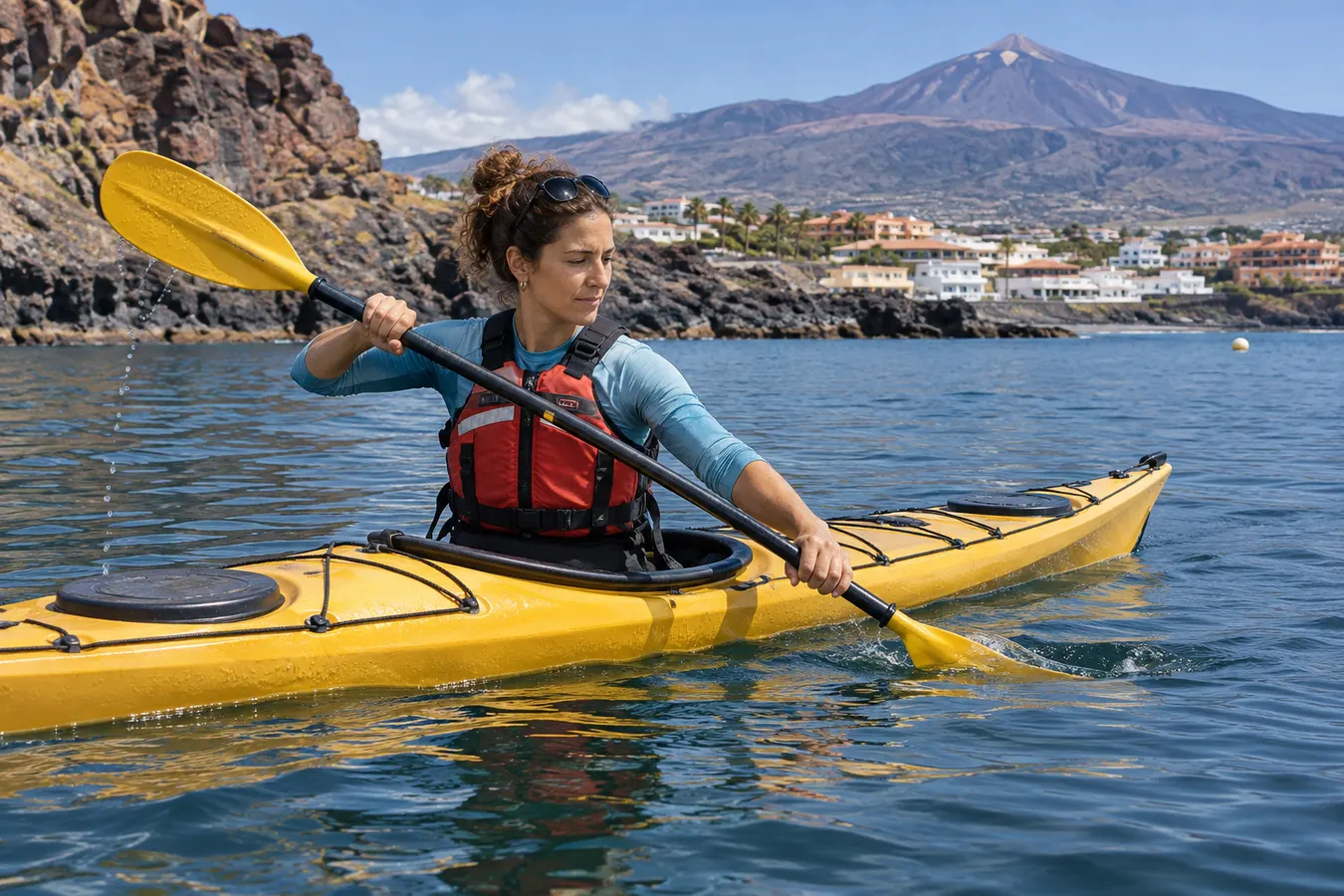
The forward stroke aims to move the kayak using contact between a blade of the paddle and the water. Although it seems like one movement at first, when learning it is useful to identify three moments: the blade entering, the phase in which it contributes to forward travel, and its release before preparing for the next stroke.
The blade enters the water towards the front of the kayak within a comfortable reach. You do not need to lean excessively forwards to reach further. When the blade works in the water, controlled torso rotation allows movements of the body and limbs to combine rather than trying to move all the weight by pulling with the arms. That rotation should suit the individual's posture and mobility.
Removing the blade around hip level, depending on technique and equipment, avoids extending the working part of the stroke unnecessarily far behind you. An instructor will observe both the quality of contact with the water and your overall coordination. If you focus exclusively on achieving a particularly forceful catch, the rest of the movement may lose its fluency.
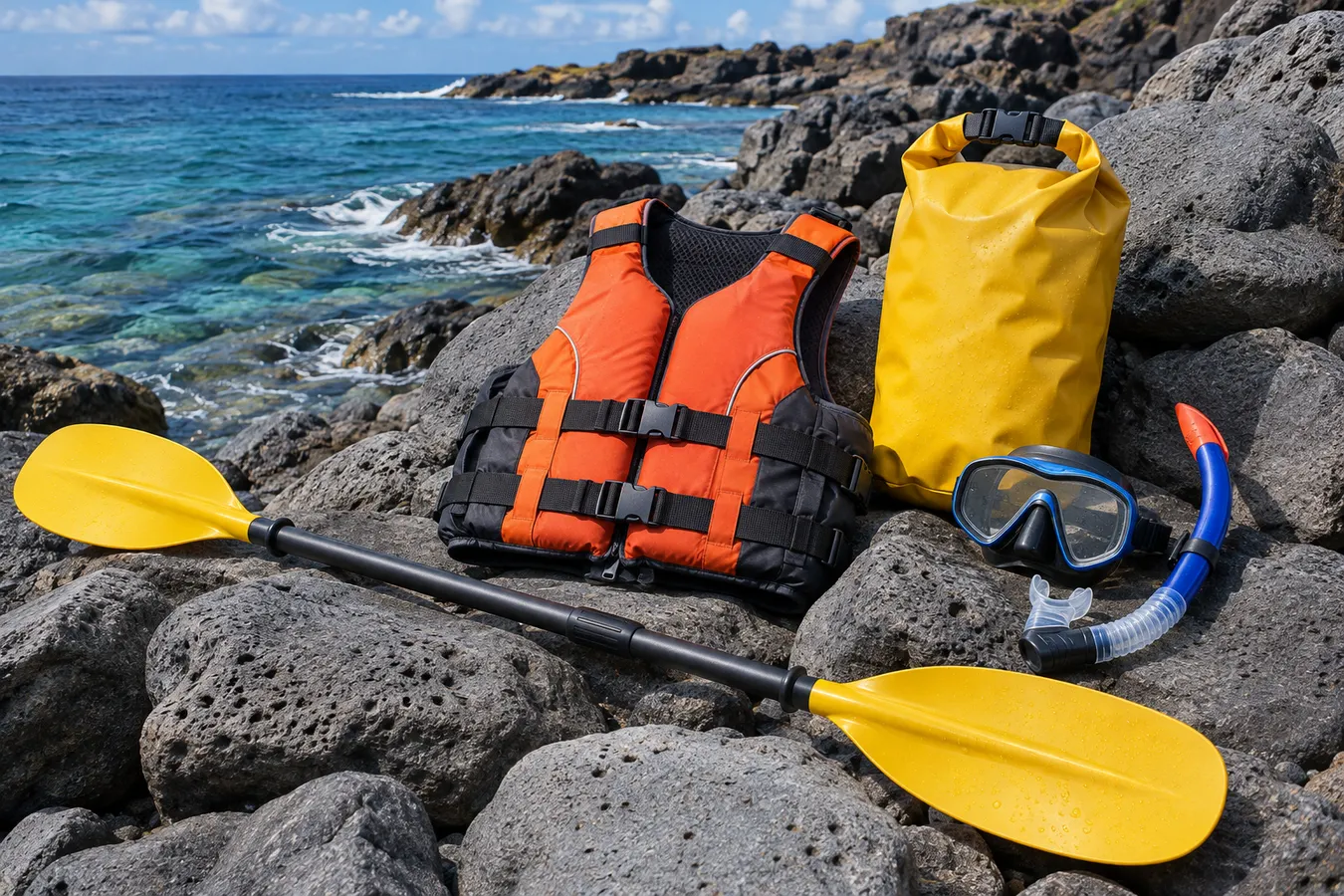
When repeating the action on both sides, seek a regular rhythm rather than a fixed speed. You are learning to recognise when a stroke has finished and prepare for the next. A short, progressive practice in a suitable location is enough to start distinguishing effort that creates forward movement from other forms of tension that do not contribute to it.
Direction, slowing down and turning
Kayaks do not always follow a straight line because strokes on each side are not identical and because the hull responds to movement, load and surrounding conditions. At the beginning of a lesson, small deviations are normal. Correcting them does not mean making steadily stronger strokes. Directional control is learned by working with different movements and observing their effect on the boat.
The sweep stroke, for example, is intended to encourage a turn, and the way it works through the water differs from a forward stroke. Stopping is another skill: it is not enough to cease paddling and assume the boat will immediately come to rest. Both movements should be learned with sufficient space, at an appropriate speed and with clear instruction. A group also needs understandable signals for stopping the exercise or altering the heading.
There are manoeuvres for moving sideways and adjusting orientation without relying exclusively on forward strokes. These techniques are useful in training but should be introduced progressively. If a movement seems to require uncomfortable force or puts the shoulder in a strained position, stop and ask for a correction. The quality of the exercise is more important than reproducing a photograph of someone using another technique or boat.
Finding a pace that works during an outing
Learning to move forwards includes discovering a cadence you can sustain. On a long trip, setting off too quickly leaves less energy for later stages and can make paying attention to your surroundings harder. During a first session, it is more useful to practise at an intensity that lets you speak, listen and correct movements without becoming exhausted.
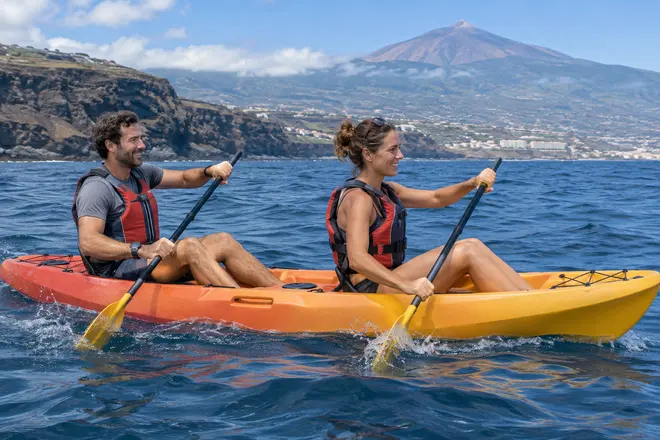
In a tandem kayak, this pace needs to be shared. Agreeing how to indicate pauses and listening to the other paddler helps avoid unexpected changes of rhythm. If one occupant tires sooner than expected, communicate that to the person responsible for the outing instead of turning the return journey into a test of endurance.
In Tenerife, marine conditions and the characteristics of the location make a substantial difference to the effort involved. Do not aim to achieve the same speed at sea as you know from a reservoir. Well-learned technique can help you use your energy, but cannot make unsuitable navigation conditions appropriate.
How to progress after your first lesson
Set aside some subsequent sessions to work on specific movements rather than simply collecting excursions. An instructor can help you identify what happens when you lose your heading, find a more comfortable sitting position or understand how to perform a manoeuvre without tensing your arms. If you change type of boat, some adjustment will also be needed.
Sea kayaking training covers many other subjects: communication and navigation, assessment of conditions, prevention of incidents and recovery techniques that must be practised under supervision. What you learn in a movement lesson does not replace the preparation required for these skills. In deciding what to learn next, consider the context in which you intend to use it.
The day you improve your forward stroke will probably not be the day you travel the greatest distance. Perhaps you will discover that your arms are less tired afterwards, you can correct a small deviation smoothly or you have more attention to spare for the scenery. These are much more useful indicators of beginner progress than setting a speed record.
Explore next: Kayaking tours in Tenerife.