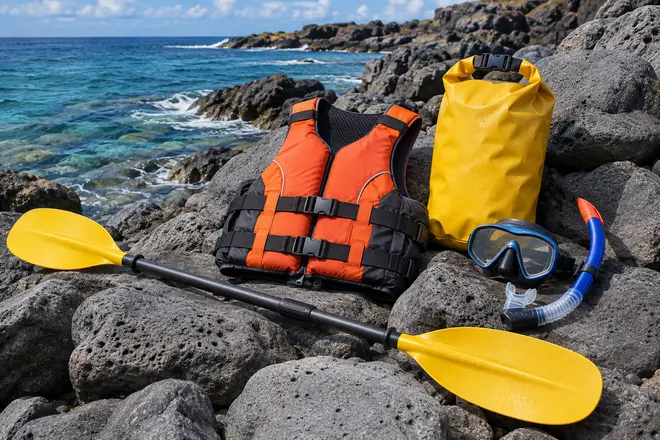
The first decision you make when looking at a row of kayaks seems simple: sit on your own or share a boat with someone else. For some travellers a tandem model is the natural option because they are visiting as a couple; people who enjoy sport independently tend to favour a single kayak. But it is worth thinking about the decision from the perspective of communication, the boat's characteristics and the skills you wish to develop.
A single kayak does not necessarily require more effort than a tandem, and a two-person boat is not automatically more stable or capable of compensating for any difference in ability. Design, load, conditions and the aim of the session affect the result. If you are considering an activity in Tenerife, these are the aspects to discuss with someone who knows the equipment and the area of practice.
What changes when you have the kayak to yourself
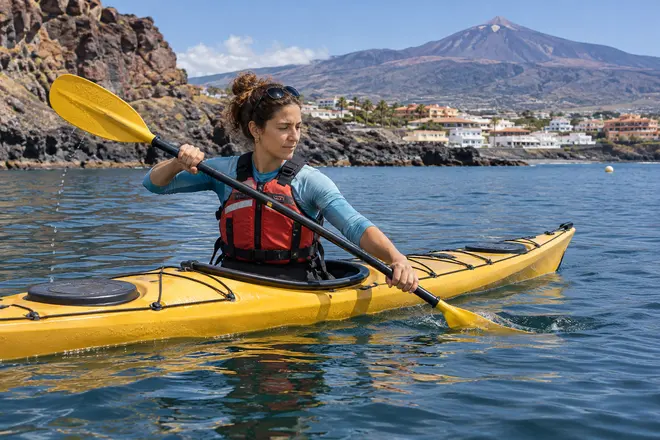
In a single kayak, every movement you make has a direct effect on the way your own boat behaves. If your pace decreases, the kayak progresses more slowly. If you change the direction in which your paddle works, the response is not combined with somebody else's actions. This relationship is interesting when learning because it is easier to associate a sensation with the action that produced it.
Having your own boat also allows you greater freedom to adjust your pauses and cadence within the instructions for the session. Some people find it more comfortable to practise a movement several times without having to explain it to a partner. In a lesson aimed at learning to direct a craft, an appropriate single kayak can allow for many useful observations by the instructor.
On the other hand, every movement depends on you. If you become tired or distracted, there is no second occupant to maintain the pace. That does not mean you need to learn to paddle in isolation: choosing a boat and organising a group are separate matters. You can use a single kayak as part of a supervised activity with other people around you.
The logic of the tandem kayak
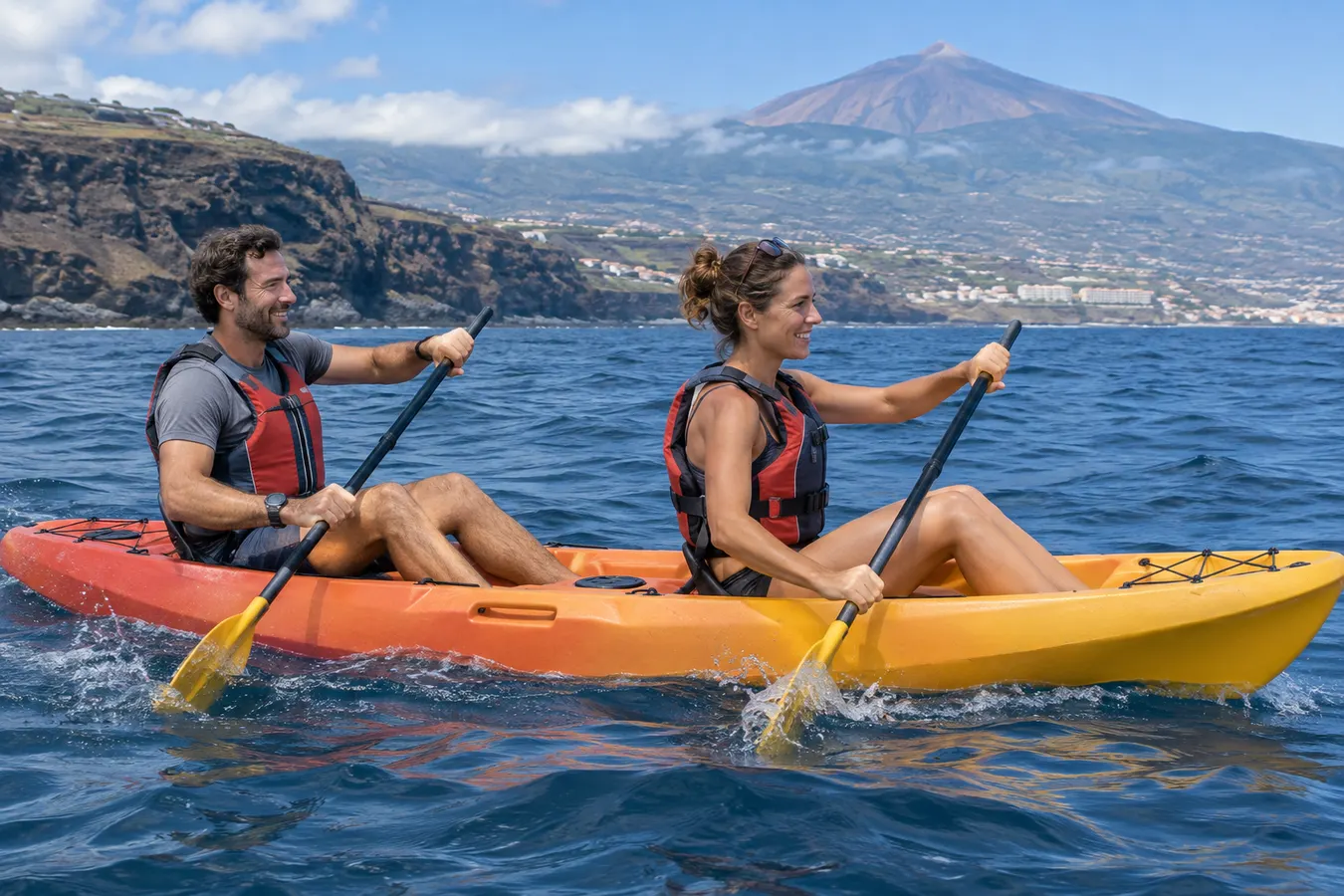
A kayak designed for two occupants has two paddling positions. It may differ in hull shape and size from another type of boat. Besides the specified load limitations, the distribution of weight affects its behaviour. Allocating the seats should not be decided simply according to who prefers the view from the front.
A shared activity adds another layer to the learning experience: finding a rhythm. Two people trying to propel the same boat with incompatible cadences soon notice that their paddles occupy neighbouring spaces. Making every movement more forceful will not necessarily solve the lack of synchronisation. Recognising a common rhythm and communicating simply are more useful than attempting to apply more force.
Related reading: Sea kayaking equipment: what you need to take in Tenerife.
Where partners have different fitness levels, the answer is not always to assign the entire task to one person. It is worth knowing how much exertion each person can manage, and both should participate in accordance with their ability and the instruction received. Two occupants have two sets of needs, including comfort, properly adjusted equipment and the ability to recover if an incident occurs.
What a shared outing feels like
Before getting on the water, talk about what each person wants from the day. One of you may be interested in paddling while the other is mainly interested in the scenery. One may prefer moving continuously while the other enjoys pauses. If those differences are not made clear, someone can quickly get the impression that their partner is holding them back or moving too quickly.
A simple exercise is to begin under supervision at a pace both can recognise. The aim is to understand the information each occupant needs to interpret the movements of the other. When an instructor explains how to coordinate and stop, listen to the instructions intended for your partner too. The boat's behaviour is shared by both people sitting in it.
A scenic route in Tenerife offers many things that can make someone forget the paddling rhythm for a few seconds: the appearance of birds, different colours on the ocean surface or a view of the mountains. Agreeing how to communicate a pause helps prevent surprises. One person should not simply stop paddling to take a camera out without the other knowing their intention and without considering whether that is genuinely an appropriate moment.
Is a tandem kayak suitable for beginners and families?
A recreational tandem may be appropriate for certain introductory activities, provided the craft and its equipment suit the people taking part and the conditions. Do not interpret this as a guarantee that any experienced companion makes an untrained second occupant suitable for a water activity. The person running the outing needs to assess both participants.
When travelling with children, ask about the age, size, swimming abilities and equipment requirements for the specific programme. Eligibility depends on the activity and limitations of the equipment. Do not assume that seating a child somewhere beside an adult in any kayak makes it appropriate. Every occupant needs a position designed for their use and suitable protection.
Sometimes families have a more enjoyable time doing different things or taking turns. An adult wishing to learn individual paddling techniques can benefit from a lesson while others enjoy the coast from shore. The intention of doing something together does not justify choosing an activity unsuitable for a member of the group.
Tenerife's surroundings influence the choice as well
Consider two different plans. One involves practising basic movements in a suitable setting selected for comfortable learning. Another is an organised scenic excursion along a coastline requiring local knowledge of conditions. The kind of boat that works well for the first scenario is not necessarily the one a specialist would recommend for the second.
Around Los Cristianos there is a combination of bathing areas, harbour activity and coastal sectors with different characteristics. Los Gigantes has steep topography with limited landing opportunities. El Médano is known for winds that can make conditions extremely unsuitable for kayaking. In none of these places does choosing two seats rather than one eliminate the need for planning appropriate to the particular setting.
One worthwhile question when enquiring about an activity is which models of kayak are normally used for it and why. Ask how equipment is adjusted for individuals, whether the combined weight fits the relevant limitations and how supervision is organised. If the answer is simply to allocate a boat based on the number of travellers, there are important details yet to establish.
When to change models as your learning progresses
Someone who has learned to coordinate well in a tandem has developed an interesting skill, but this experience does not necessarily demonstrate equivalent ability in a single. The movements of two paddlers combine in a tandem and can disguise particular mistakes. Individual practice reveals other aspects and allows you to take personal control of every movement.
The reverse situation is also possible: a person accustomed to a single kayak may have difficulty coordinating with a partner. Shared learning demands attention to both the boat and communication. It is a valuable competence for group activities, even with people of similar abilities.
The most interesting choice is the one appropriate to the aim for your day. If you want to improve your own technique in a lesson, ask whether you can use an appropriate single. When seeking a supervised experience to share with somebody else, a tandem can make a great deal of sense provided all relevant requirements are met. The model is a tool for learning and enjoyment, not a category that determines the quality of the day.
Explore next: Kayaking tours in Tenerife.