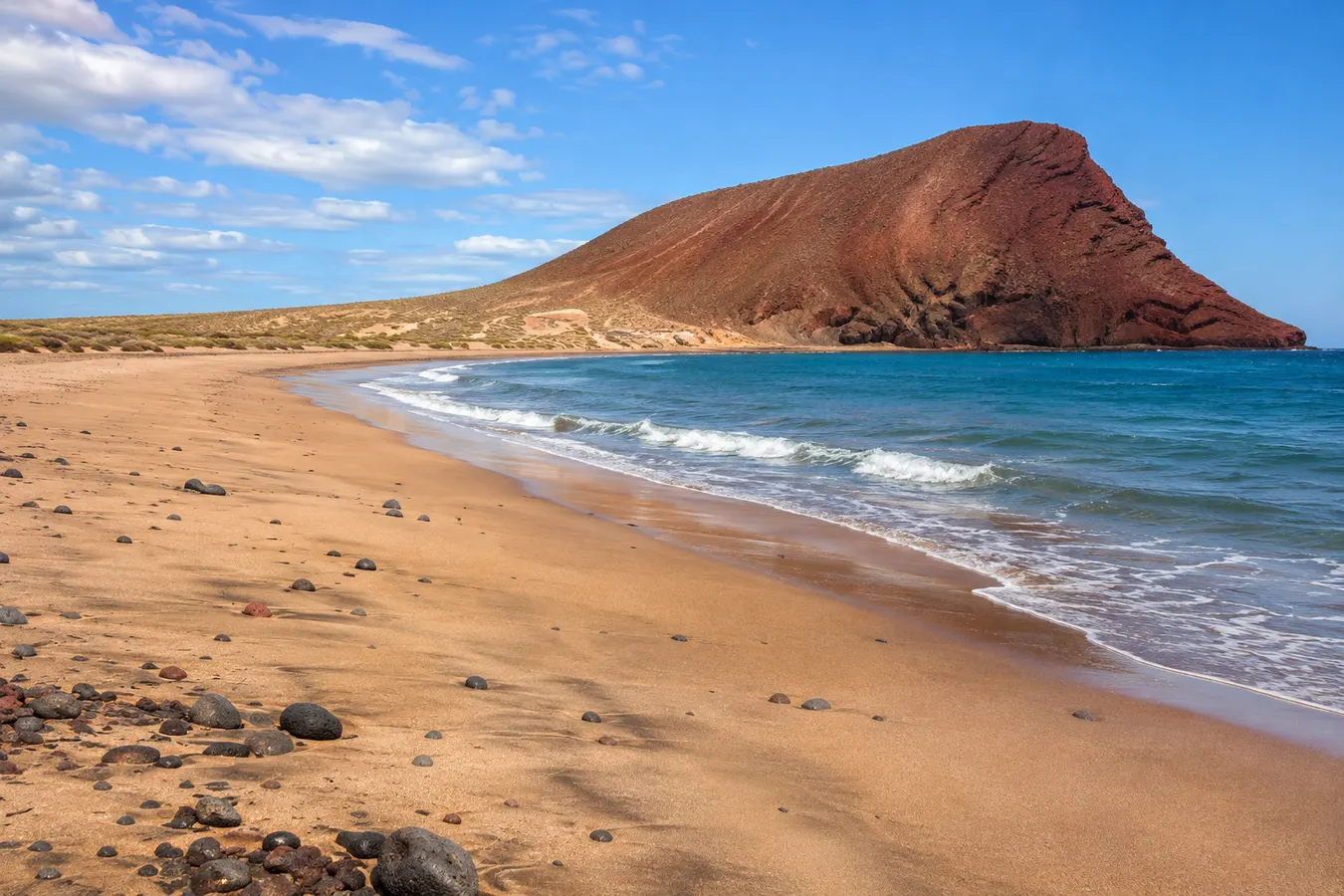
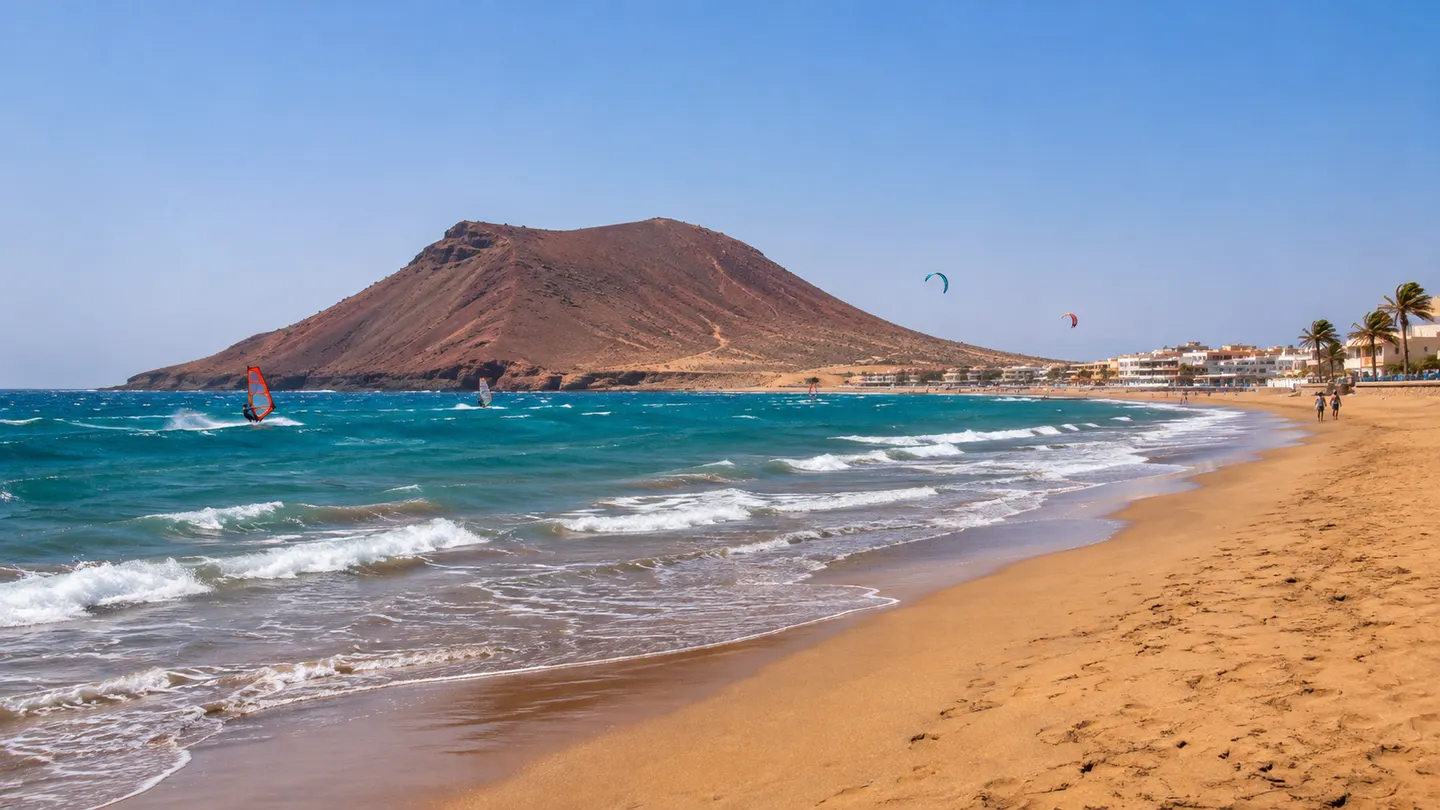
Seen from the road between El Médano and Los Abrigos, La Tejita resembles a ribbon of land between arid ground and the deep blue of the ocean. The cone of Montaña Roja dominates its eastern end. Unlike many developed parts of southern Tenerife, the mountain here appears to rise directly out of the sand, without a row of buildings concealing the point of contact. The scene changes with the time of day. Reddish and brown tones stand out in low sunlight, while the brightness at midday makes the contours more subtle. Wind, which is a feature on many days, continues to shape the scene and plays a part in determining what you can do here.
Visiting a beach within a protected landscape
La Tejita is about a kilometre long and occupies part of a protected area of Granadilla de Abona. Visitors approach on foot from access points near the road linking El Médano and Los Abrigos. There is no need to create an individual path through the bushes to reach the sand directly from wherever you have parked. The ground may appear empty at first glance, but many of the plants growing beside this dry shoreline have adapted to extremely specific conditions of soil, salt and wind exposure. Repeated foot traffic in the same places eventually leaves marks that take a considerable time to disappear.
An image of a wild beach does not imply the absence of human activity. La Tejita appeals to residents and visitors looking for a less urban seaside setting. It is also a beach where naturism is practised, and coexistence between people with different ideas of enjoying the coast is part of its character. Be considerate of other people's privacy, particularly when using a camera. Rather than taking photographs including beachgoers who have not given their consent, seek an angle on the volcanic cone, the sweep of sand or the ripples left by the wind in the drier areas. You will find plenty of interesting subjects without incorporating anyone else into your picture.
Anyone intending to spend several hours here needs to remember that not all parts of the beach have the amenities of an urban beach. Facilities have a limited extent and may change. Bring drinking water at the outset and have a practical arrangement for keeping your belongings together. A light, closed bag that is easy to carry works better than a large number of loose items spread across the sand. Do not use areas of vegetation to assemble an improvised shelter or as a convenient place to leave rubbish, even if you intend to collect it a little later.
Montaña Roja, a landmark for walkers
The unmistakable form of Montaña Roja helps you understand the position of La Tejita on the south-eastern coast. El Médano and its principal beach lie on the opposite side of the cone. Exploring the authorised paths and visitor access areas reveals a contrast between consolidated volcanic material and loose deposits accumulating in lower ground. The lack of long shadows around the middle of the day also makes you notice the importance of variations in elevation in an apparently simple landscape. A slight change of direction may be enough to alter the sensation of the wind against your skin.
Related reading: Playa del Duque and Costa Adeje: a day of beach walks.
Anyone wishing to explore Montaña Roja on a walk should establish which routes are open, whether any weather warnings are in place and the rules specific to this protected area. A permitted footpath is not permission to leave it and explore any slope of the hill. Loose ground can make ascending and descending difficult, and sun exposure is considerable. It is better to set out on a modest walk and return with some energy left than to combine an ascent and an afternoon of water sports without an opportunity for rest. Reaching a summit is not a prerequisite for enjoying the volcanic surroundings.
The appeal of Montaña Roja is not confined to the views from high on the mountain. Even from authorised vantage points near sea level, the cone stands out above this substantial area of relatively low-lying shore. You can see how the volcanic contours and colours change according to the light. A simple camera will provide interesting images incorporating the general outline of the mountain or showing details of sand and rock. There is no need to approach edges, leave established paths or intrude into vegetation to obtain a photograph. Making the most of whatever can be seen from your designated route is part of the enjoyment.
Wind and its implications for water sports
The area around El Médano draws many people who participate in wind-powered water sports. Their presence does not mean you can choose any point along La Tejita for an unrelated water activity. Wind that you feel on the sand may vary in direction and strength across the water and combines with the effects of the waves. For swimming, the beach flag and instructions from any officials responsible for the beach take precedence over a visitor's impressions from the shoreline. If the area is not supervised or you are not sure conditions are appropriate for entering the sea, choose another pursuit.
On a paddling outing, for example, there are different requirements from a day spent entirely walking. The ability to carry a lightweight craft from a parking area to the beach is not an indication that the location is suitable for launching. Participants need to understand local limitations and the sea conditions; anyone having their first experience needs suitable instruction and an appropriate location. Areas designated for other sports must remain clear for their users. At La Tejita there will be days when the most enjoyable itinerary for understanding the coast is one spent entirely on land.
Nor is it a good idea to remain for a prolonged period on the beach simply because you are not going into the sea. Wind blows loose objects away, can reduce your perception of the heat and adds to the tiredness of walking. A pause in a permitted, sheltered place allows you to assess whether you feel like continuing the visit. If airborne sand is becoming uncomfortable or adverse weather is forecast, returning in good time towards the road is a far better decision than trying to seek some shelter beside a potentially unstable slope.
Combining La Tejita with El Médano and Los Abrigos
After La Tejita it is natural to continue the outing in one of the two neighbouring settlements. El Médano has a lively atmosphere, with squares and café terraces near the beach promenade. Los Abrigos presents a different setting, centred on its coastal village and harbour. You could devote the morning to the natural landscape followed by a meal in one of the villages, keeping the other for a shorter afternoon visit. This avoids carrying everything for a day's activities along the sand with you. Plan journeys using permitted access routes, keeping to pedestrian areas and respecting any temporary restrictions that may be in place.
To choose the best time for taking photographs or going for a walk, think about the length of time you will be in an exposed setting, not just the hour of sunrise. In the early morning there can be a subtle contrast between sand and mountain. When sunlight strikes at an angle, other gradations of colour become apparent. On an exceptionally breezy day or a day with adverse weather warnings, it is not worth forcing yourself to complete a plan that seemed appealing at home. La Tejita makes sense as part of a flexible itinerary. Its attraction lies in the relationship between sand, volcanic landforms and sea, three elements you can enjoy without entering the water or leaving public access routes.
Explore next: Kayaking and snorkelling in Tenerife.