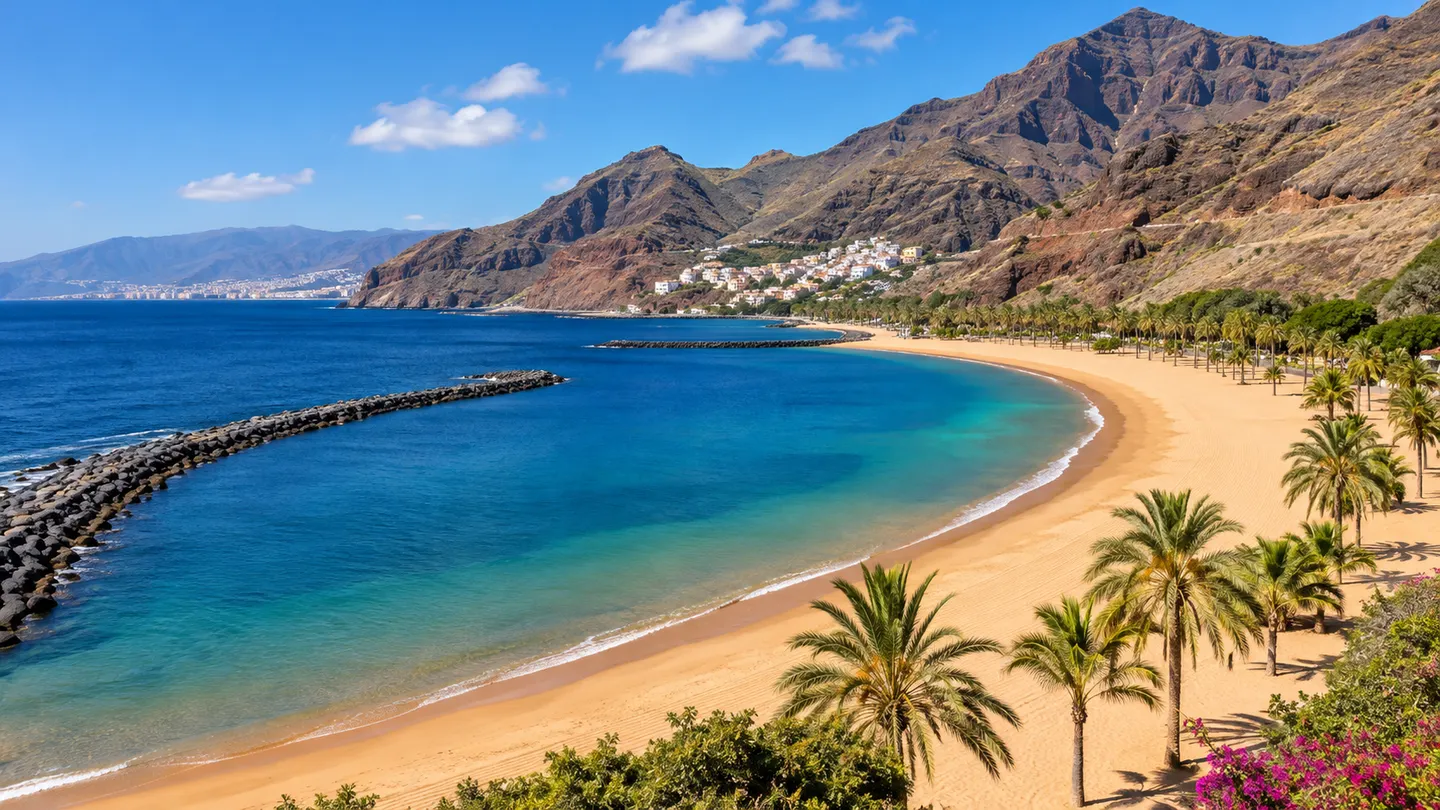
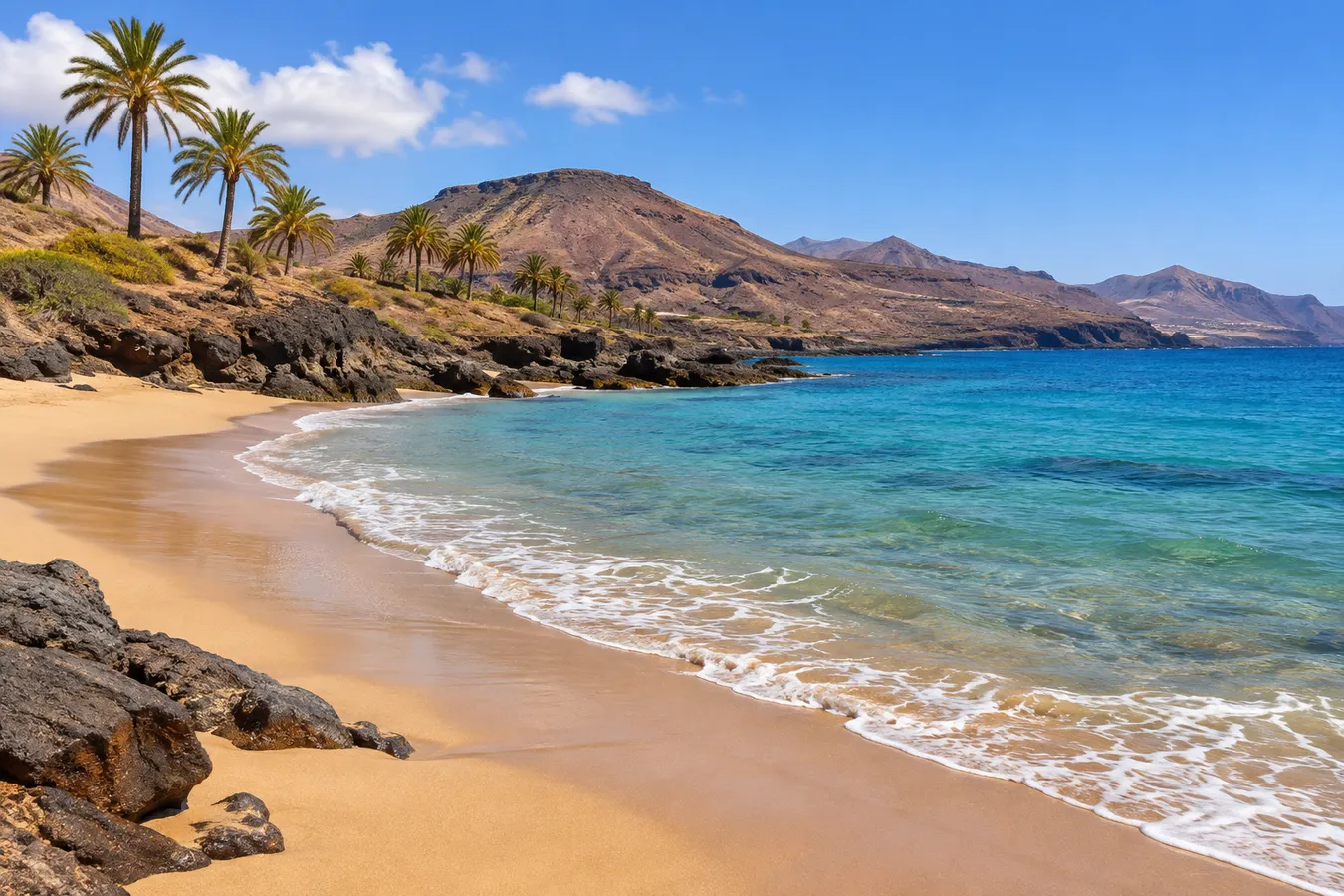
Arriving in San Andrés from Santa Cruz, the sight of Las Teresitas contradicts the usual image of a volcanic island. A ribbon of pale sand opens beneath the Anaga mountains, punctuated by rows of palms, with a long barrier of rock offshore. The buildings of the village are concentrated at the end nearest the capital; at the other end, the beach approaches the dry slopes of the mountain range. This combination of built-up shore and mountains is one reason to include Las Teresitas on an itinerary also dedicated to the forests and ravines of the north-east. You do not have to reserve an entire day to appreciate its unusual setting.
A different beach from its neighbours in Anaga
Las Teresitas has not always looked like this. During the twentieth century, the beach was transformed by the addition of sand and by structures designed to shelter it from waves, changing its relationship with the Atlantic. The result is considerably different from the rocky, dark-sand beaches on the other side of the Anaga range. Although the volcanic landscape dominates the backdrop, the ground on which people spread their towels is pale in colour. At the edges and in the protective structures themselves, you can see the dark rock characteristic of much of Tenerife's coast.
The length of the beach, around 1.3 kilometres, offers advantages for anyone arriving with the idea of going for a walk. There is ample space to explore different sections and see how the mountains appear to change shape as you move along the shore. The palms are among its most distinctive features, but their shade covers a small proportion of the total area. Do not assume that you will be able to find a cool place without bringing a parasol or using an established resting area. Sun exposure can be considerable even on a day when cloud covers part of the sky.
The water beyond the breakwater belongs to a very different marine environment from the water between the barrier and the beach. The protective system reduces the effect of some waves but cannot eliminate every risk. Remain within the designated bathing areas and keep away from structures and passages where access is not permitted. Do not scramble onto the breakwater to take a photograph, a matter of ordinary good judgement that becomes particularly important during heavy seas. From the sand you can perfectly well appreciate the contrast between the open ocean and the more sheltered area without going anywhere near the outer rocks.
Getting here from Santa Cruz
If you are staying in the capital, you can reach San Andrés along the coastal road by public transport or by car. Check public transport timetables when planning your trip and avoid relying on finding a parking space right beside the beach at the busiest hours. At weekends in particular, Las Teresitas serves as a recreational area for local residents. A visit early in the day offers a view of the everyday activities of San Andrés before most beachgoers have arrived. Having a little extra time gives you the freedom to walk rather than rush to claim a spot beneath a palm.
Related reading: The best beaches in Tenerife for an active holiday.
One of the beach's advantages is the existence of facilities and prepared access routes. Toilets, showers and places to buy something to eat mean that you can organise an outing without carrying everything necessary for a remote beach. Even so, it is worth checking that any essential facilities are operating, especially outside the busiest season or following closures for maintenance. Someone who finds it difficult to walk across sand should enquire about the accessible entry arrangements in operation at the time of their visit. Such practical details make more difference to a day out than a general description of the beach as accessible.
The most convenient place to settle on the beach depends on your intentions. A group with children will find it practical to remain near established access points and supervised bathing areas. Someone primarily interested in walking will appreciate the length of the shore and have less need to occupy one precise spot all morning. If you are travelling without a car and intend to continue on foot into the centre of San Andrés, the western end of the beach is particularly convenient. You do not have to settle in one spot at all: a little time walking and a little time in the village can be more rewarding than remaining on a single sun lounger.
Bathing and water sports: calm does not mean safe
The relatively sheltered bathing area has made Las Teresitas well known as a family beach. Nonetheless, the offshore barrier does not turn the sea into a swimming pool. The beach flag and the instructions from lifeguards indicate whether bathing is permitted and what precautions apply. A red flag means remaining out of the water, even if one particular patch looks calm. Children need close and continuous supervision, whether or not they have a flotation aid. These points are not intended to reduce a beach outing to a collection of prohibitions, but to make it possible to enjoy the surroundings while being aware of its limitations.
Board and paddle sports involve different considerations from ordinary swimming. If you plan to learn a water sport, seek appropriate instruction and use the designated areas, subject to both local rules and the weather. A day without large waves can still have sufficient wind to make a proposed activity difficult. Seeing an enthusiastic person arriving on the beach with a board is not a good guide to the actual state of the sea or the areas where launching is permitted. If conditions are inappropriate, the walk along the shore is still an excellent alternative. There is no need to let a change of plan spoil the morning.
Snorkelling need not be the principal activity on a visit to Las Teresitas, either. Sandy seabeds provide a different scene from the volcanic rock habitats found in other parts of Tenerife. It is worth accepting what a particular setting offers rather than seeking a place to look for fish at all costs beside a hazardous structure. Do not leave designated areas in search of marine life. Looking carefully beneath the surface, when swimming is permitted and conditions are suitable, already provides a glimpse of the variety of life beside the shore. If you are a first-time snorkeller, remember that suitable instruction is important, even in fairly sheltered surroundings.
Continue the day in San Andrés
Unlike many resort complexes set apart from established settlements, the beach is not separated from its neighbouring village. San Andrés has a waterfront and streets leading down towards the coastal avenue. After a walk along the sand, it is pleasant to explore these streets and find somewhere for a fish lunch or a simple dish from the Canarian kitchen. From this side you can also appreciate the meeting of the Anaga valleys with the sea. It is an outing on a human scale, featuring the details of a fishing settlement that tend to go unnoticed if you use the village purely as a route to the beach.
With a few more hours to spare, San Andrés can be combined with a cultural visit to Santa Cruz. The city centre has tree-lined squares, spaces overlooking the port and an urban layout that provides a contrast to the beach. Another idea is to devote the remainder of the day to established viewpoints in Anaga, bearing in mind that travelling along its mountain roads can take time and that not every walking route has unrestricted access. Do not try to add a demanding hike through the ravines after several hours in the sun. Allowing time for rest is a sensible part of the itinerary.
Packing a small bag for the day
For Las Teresitas, a few things will do: drinking water, light clothing, sun protection, a hat and comfortable shoes for moving between the beach and the village. If you intend to remain by the sea until late in the day, a light extra layer will be useful when the breeze becomes cooler. Anyone intending to hire equipment for a water sport need not carry their own from their accommodation before establishing whether they will be able to use it. Bulky luggage is awkward if the trip continues by public transport. At such an accessible beach, travelling light means you can move around freely and swap the sand for the streets of San Andrés whenever you feel ready.
Explore next: Kayaking and snorkelling in Tenerife.