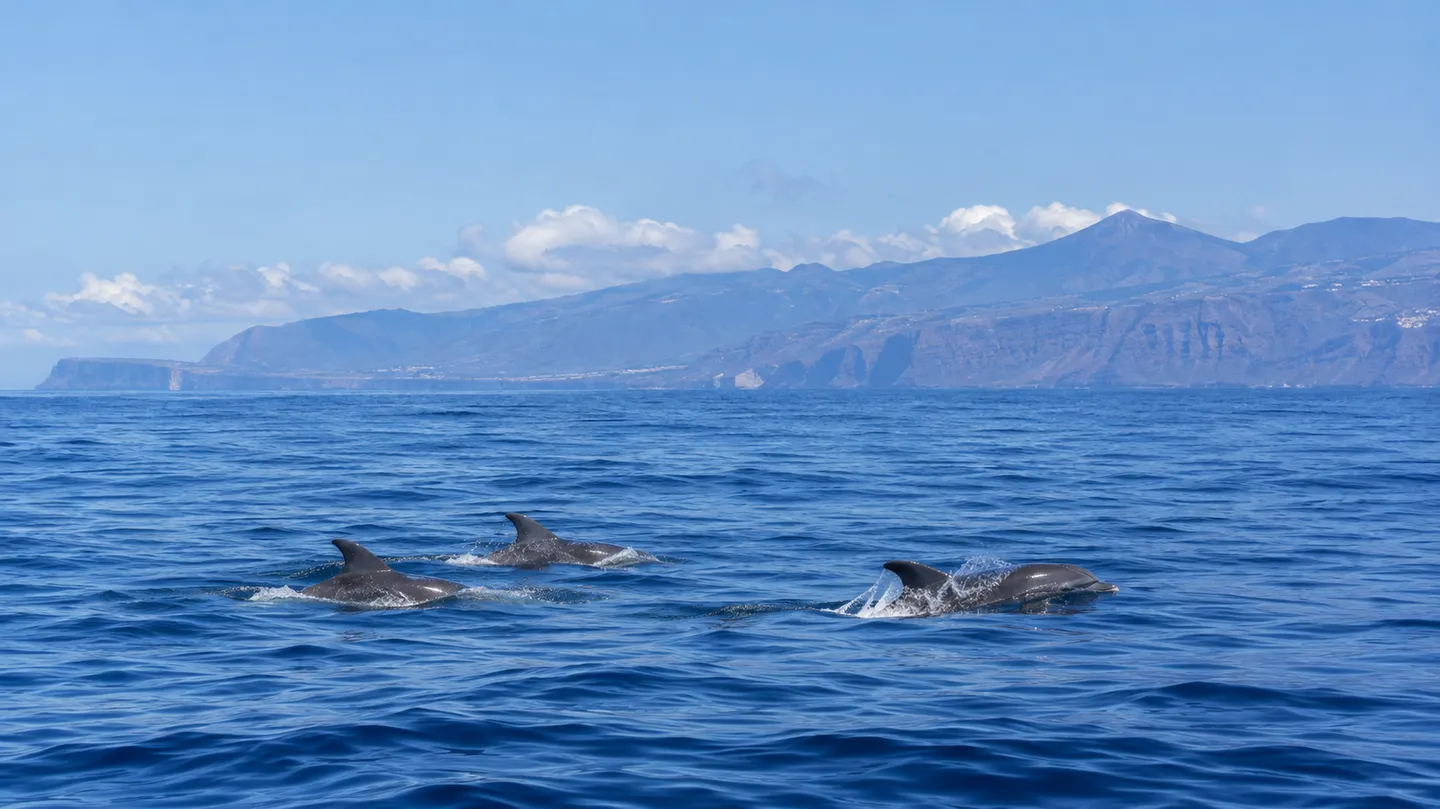
From Tenerife's south-west coast, the sea between the island and La Gomera looks like a uniform expanse of blue water. Beneath the surface, however, is a deep marine environment supporting very different species from the ones found beside the beaches. The presence of resident cetacean populations explains why wildlife-watching excursions feature alongside other nature activities in Tenerife for much of the year. This kind of trip has a different purpose from an excursion to swim or take part in a sport. It provides the opportunity to see animals in the wild, in the surroundings that they use for travelling, resting and looking for food, without disrupting those activities.
Why the south-western marine area matters
The Teno-Rasca area encompasses a substantial part of the waters west of Tenerife, off municipalities including Buenavista del Norte, Santiago del Teide, Guía de Isora, Adeje and Arona. The Teno-Rasca marine strip has been a Special Area of Conservation since 2011. This is not simply a tourist location where shipping routes and leisure vessels happen to converge, but a protected area because of the significance of its habitats and species. Recreational activities should be understood in that context. The relative abundance of certain animals does not remove the pressures that boat traffic, noise and the concentration of vessels can exert on them.
The possibility of seeing cetaceans throughout the year is linked to the presence of short-finned pilot whales and bottlenose dolphins. These populations are not limited to the individuals visible from boats on the most commonly travelled routes. They occupy a changing environment, move around and vary their behaviour according to what is happening. For this reason, a well-managed outing cannot guarantee that the animals will perform particular movements or appear at a given distance from the boat. The better you understand their behaviour, the easier it becomes to appreciate that the absence of a close-up photograph does not mean that the day has been a failure.
Recognising what appears above the surface
The short-finned pilot whale is a cetacean belonging to the dolphin family, despite its familiar name. It has dark colouring, a rounded head and a distinctive dorsal fin whose outline helps distinguish it from other animals. Often the portion visible above the water is very small in relation to the animal's total size. At times you recognise the shape of a back and fin for just a few seconds. On other occasions you may observe several individuals at the surface. The mere presence of several backs does not allow you to say with certainty what their relationships are or what the animals happen to be doing.
The bottlenose dolphin has a different shape, with a distinctive dorsal fin and a more pronounced beak. Lighting conditions, distance and the angle from which the animal is seen make it difficult to identify every species. Other cetaceans also occur in the waters around Tenerife, but there is no equal probability of seeing them all. Avoid the temptation to classify every sudden movement on the surface as a jumping dolphin, or immediately to assign a precise species to an animal of which you have barely seen a small portion. Careful interpretation from someone familiar with the local wildlife is worth much more than an unreasonably long list of supposed sightings.
Related reading: Tenerife's coastal walks and trails for exploring the island on foot.
Choosing an excursion that respects the regulations
Recreational cetacean watching in Spain is regulated and subject to prior authorisation. When choosing an excursion, establish that the vessel has the appropriate authorisations for the activity and the area in which it will take place. Teno-Rasca has specific requirements connected with conservation of the protected marine environment. The harbours of Los Cristianos, Puerto Colón and Los Gigantes are familiar departure points for marine excursions, but sailing from one of these ports does not demonstrate in itself that any particular vessel is authorised to offer wildlife watching. Applicable permissions and an explanation of behaviour on board are among the matters worth checking beforehand.
The regulations establish an exclusion zone extending at least 60 metres around cetaceans. A deliberate approach within that zone is prohibited. They also regulate navigation close to the animals, coordination between vessels and the length of the observation. The purpose is to reduce interference with the animals' movements and other activities. If animals appear unexpectedly alongside a vessel, it is the crew's responsibility to act in accordance with the applicable regulations. Passengers should not encourage a closer approach, ask the crew to pursue an animal group or insist on extending the stop to obtain an individual photograph.

Certain activities are incompatible with responsible wildlife watching: feeding or touching cetaceans, trying to swim with them, creating noises intended to attract them and throwing things into the water. An outing should not feature these activities or promote them as additional benefits. It is also incorrect to assume that using a small craft without a motor removes the need to respect wildlife. On a kayaking outing, the unexpected appearance of a cetacean must not become an opportunity for a pursuit. Keep a distance, avoid interaction and follow the instructions of the person responsible for the activity, taking into account both the safety of participants and the rules that protect the animals.
Enjoying the observations from the vessel
The first minutes of an excursion give you time to become accustomed to the movement of the boat and to look at the shoreline from an unfamiliar angle. During the journey, remain in the areas designated by the crew, particularly when the boat is moving or changing course. Children need supervision. The wish to see an animal that has just appeared on the other side of the boat is not a reason to hurry across the deck, climb onto railings or move to a part of the vessel where passengers are not permitted. Part of a well-organised trip is being able to listen to explanations even at a moment when there happen to be no sightings.
Photography has its limitations at sea. A telephone might capture the general seascape perfectly well and show very little detail of a distant fin. Making use of whatever zoom is available and accepting that many pictures will simply be modest souvenirs allows you to enjoy the activity more calmly. Rather than spending all your time looking at a screen, take an opportunity to observe the emergence and disappearance of various individuals at the surface. Your eyes can follow a movement for longer than a camera pointing at one fixed spot. Do not use equipment involving flying a device close to the animals or attempting to introduce a recording device into the water alongside them.
What to bring and alternatives for a day on the coast
Although the temperature may be very pleasant in the harbour, it is sensible to bring a light extra layer, sun protection and drinking water. Wind and spray can make the conditions feel cooler. If you are prone to seasickness, think in advance about the length of the voyage and the forecast conditions, and seek advice from a healthcare professional if you have questions about medication. An outing at sea has little appeal if it turns into several hours of discomfort for one of your companions. Select the format of the excursion according to the needs of everyone in the group, rather than exclusively on the basis of the price or the advertised number of hours.
When the excursion cannot take place, there are good alternatives on land. From certain vantage points on the coast, you can see the waters frequented by cetaceans and sometimes spot an animal from the shore, although there is no reason to take such an encounter for granted. A walk in Los Cristianos, Puerto de Santiago or Alcalá offers a chance to see the state of the ocean and appreciate the scale of the shoreline. Whether you are at sea or watching from the land, the essential thing is to understand that the animals belong to an ecosystem rather than participating in a scheduled show. A worthwhile visit ends with the group of cetaceans being able to continue whatever it was doing before the people arrived.
Explore next: Kayaking and snorkelling in Tenerife.