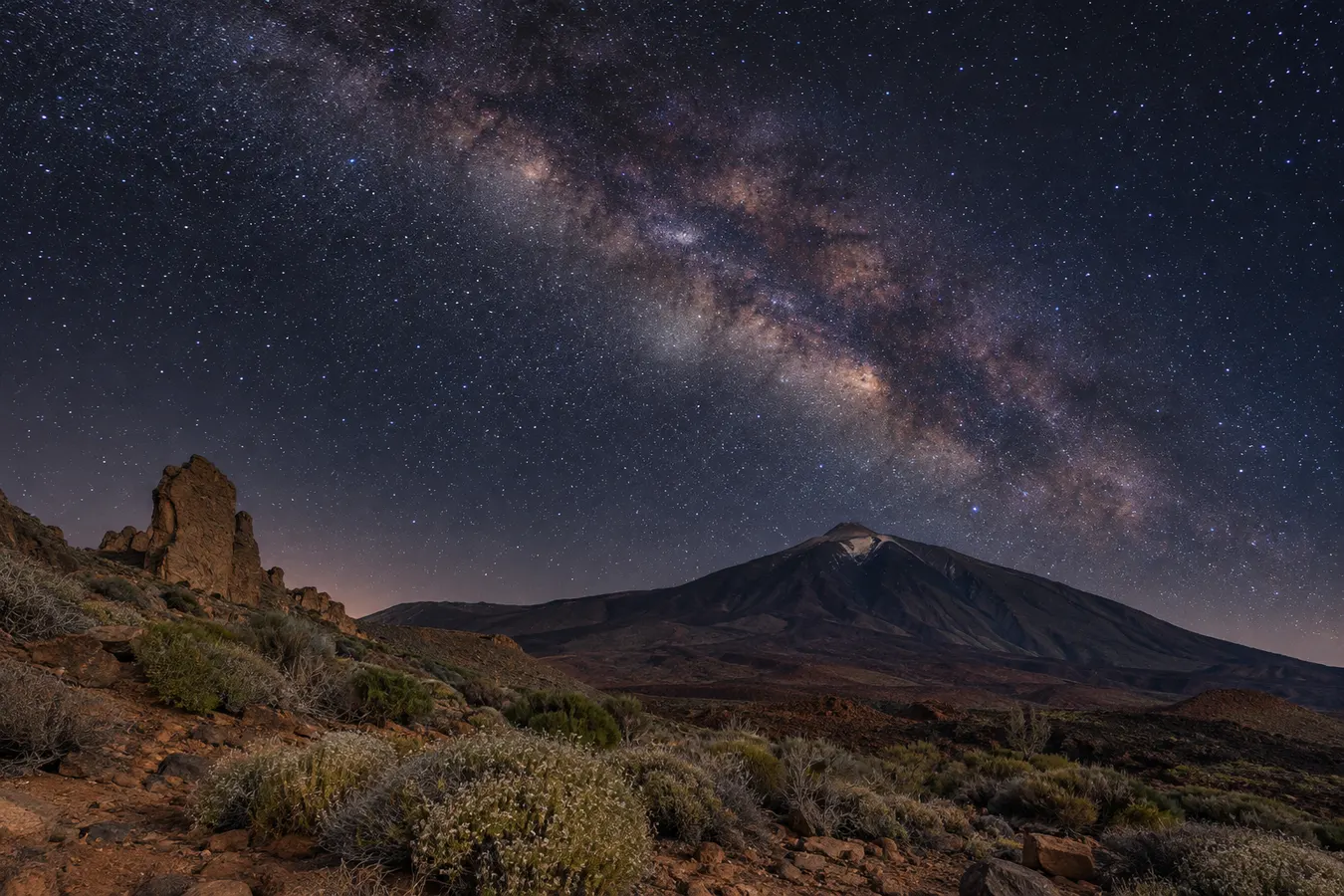
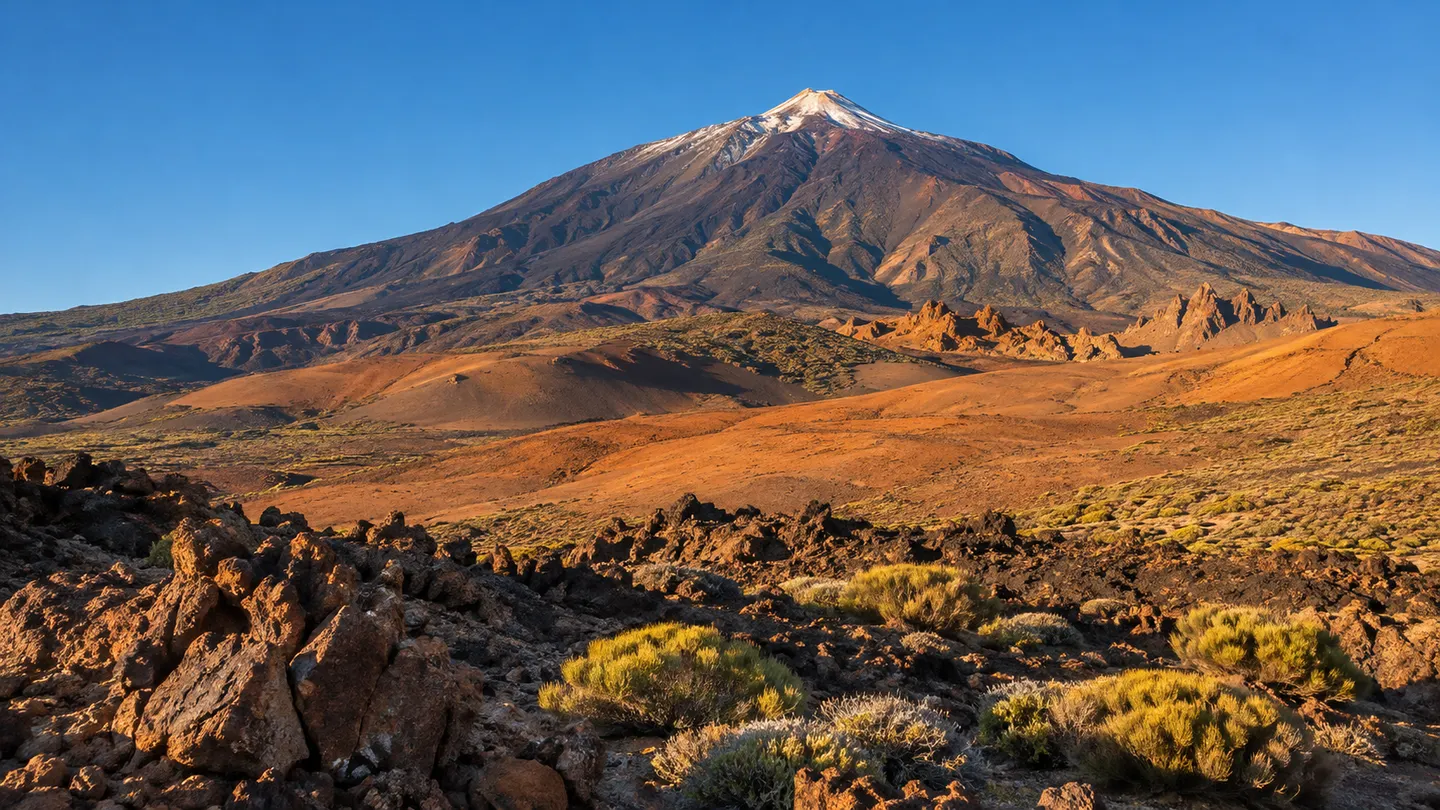
When the last light of day fades at Las Cañadas, the landscape loses many of the colours that make it familiar. What remains is the outline of Teide and the profiles of the mountains surrounding the horizon. Above them, stars start to emerge that were invisible near built-up areas. You do not need a telescope to appreciate them.
Tenerife combines conditions favourable to astronomical observation, associated with elevation, atmospheric transparency and opportunities to find places away from direct sources of light. It does not, however, promise clear skies every night. The quality of the experience depends on both timing and the location from which you observe.
Why altitude and clouds matter
Teide and the central mountains often stand above a layer of cloud affecting lower elevations. This phenomenon, associated with the trade winds and the structure of the atmosphere, explains why the sunshine sometimes reaches the mountains while large parts of northern Tenerife remain under cloud.
The distinction between being above and below the clouds is important at night as well. If the cloud layer is low and the skies above the mountains are clear, you may have a broad view of the night sky while people in other parts of the island can see very little.
There are exceptions. On some days clouds affect higher elevations, and Saharan dust reduces atmospheric transparency. Wind and cold may make observation difficult even when the sky itself looks promising. A specific mountain forecast is more useful than trying to deduce the conditions from the temperature on the beach.
Tenerife’s proximity to the tropics also makes it possible to observe areas of the sky different from those familiar in places much further north in Europe. Some celestial objects appear at different elevations above the horizon, while others are visible only during a certain part of the year.
Choosing the night according to what you want to see
If you want to see the Milky Way and faint objects, a dark sky is desirable. Light from the Moon may obscure faint structures even in an environment far from urban areas. Nights around the new moon are often particularly interesting, provided the weather is favourable.
Someone who is curious about the craters and mountains of the Moon needs a different approach. Near the dividing line between the illuminated and dark regions, shadows make surface features easier to distinguish. You do not need to wait for a full moon; a partial phase may reveal the lunar topography particularly well.
To find planets, it is useful to know when they appear above the horizon. Their apparent positions change, and the suitable time for observing them is not the same throughout the year. A planisphere and an up-to-date star map help you orient your gaze without having to identify every bright point individually.
If you are spending several days in Tenerife, it is sensible to keep the timing of your stargazing flexible. That way, a cloudy date can be exchanged for a more suitable one. New moon under an entirely overcast sky is not much use for visual astronomy.
Related reading: Volcanic Tenerife: reading the rocks from Teide to the beaches.
Observation locations and their limitations
Teide National Park has designated areas providing extensive views of the sky. When selecting a location, consider ease of access, the absence of obstructions and distance from bright lights.
There is no need for a night-time hike just to get a little distance from a suitable parking area. Volcanic terrain is uneven and changes in elevation are difficult to spot in darkness. Do not enter mountain trails at night without preparation or use road shoulders and places where parking is prohibited.
Night access to certain areas may be restricted, and road conditions should be checked before heading up to the mountains. Organised activities within particular protected areas are subject to their own rules. If you want an interpreted experience, seek guides who know the area and work in accordance with the necessary authorisations.
Even in a dark location, bright lights may occasionally appear. Car headlights affect eyes that have become accustomed to low illumination. Your eyesight recovers with patience, but finding a location protected from direct traffic glare helps improve the experience.
Learning to observe without complicated equipment
Your eyes are the first tool of astronomical observation. Once you stop looking at a brightly lit screen, more and more stars gradually become discernible. This process of adapting to the darkness takes time.
It can be useful to start by locating a recognisable pattern of stars and use it as a reference for finding others. Not all constellations sit high above the horizon at the same time of year, so a chart for the date and time of your observation is more valuable than committing a list to memory.
A dim red torch helps you consult a map without losing so much of your adaptation to the darkness. Use it only when necessary and avoid pointing it at other people. If you need to use a phone application, you can also reduce screen brightness and silence notifications.
Binoculars offer a different field of view without the need to carry bulky equipment. They allow you to observe details of the Moon, groups of stars and some areas of higher star density. For prolonged viewing, a comfortable support helps keep the image steady.
Never use optical instruments to look at the Sun without appropriate, dedicated solar protection systems. Accessories intended for night-time use do not make the equipment safe for solar observation.
Photographing the volcanic sky
A picture combining the stars and the outline of Teide requires a rather different composition from a photograph of an illuminated urban scene. The mountain may appear almost black while the exposure needed to capture the stars reveals colours that do not look the same to the naked eye.
Place your tripod on a stable surface away from routes used by other visitors. It is better to test the composition before complete darkness arrives, without moving your equipment towards the edge of uneven ground in an attempt to alter the silhouette.
A particularly long exposure may reveal the apparent movement of stars due to Earth's rotation. This is not necessarily an error: it depends on whether you are aiming to capture pinpoint stars or trails. Lenses of different focal lengths also change the way that movement appears.
However, lights from passing vehicles can affect a photograph when you did not intend to capture such an effect. Patience and a suitable location are usually more useful than extra equipment.
What to bring and combining the night with other activities
Observing at high elevations requires different clothing from that worn on a sea-level kayaking trip. Staying still for an extended period of time makes the cold more noticeable than when walking. Insulating layers, closed footwear and a warm drink are particularly useful.
Bring a torch for safe movement, sufficient charge in your mobile phone and water. The return journey involves mountain roads, so it is not a good idea to accumulate fatigue with a highly demanding hike and then extend the day late into the night.
An active week in Tenerife can include a quieter day in the vicinity of Teide, with a short afternoon visit followed by stargazing if conditions are suitable. On other days, the coastal landscape provides opportunities to look across an ocean horizon and follow the rising or setting of celestial objects from designated public locations.
You do not have to choose between mountain and ocean to appreciate the sky. During one holiday you can notice how stars disappear behind the lights of a promenade and reappear in the darkness of the high mountains. The full experience brings together two distinct parts of the journey: the territory you discover in daylight, and the space above it that emerges when that light fades.
Explore next: Kayaking in Los Gigantes.